
As you may be aware, Red Hat OpenShift is emerging as a strong contender to be a single platform for all workloads: Containerized applications, AI, and virtual machines.
With Veeam Kasten — Kubernetes-native data protection backed by a long-standing Red Hat partnership and proven at scale across cloud and air-gapped hybrid deployments —organizations can modernize with confidence, as traditional virtualization platforms fall short for cloud-native, declarative architectures.
In this post, you’ll learn how Red Hat and Veeam are advancing storage-agnostic KubeVirt change block tracking (CBT) and the ultimate goal: Faster, more efficient VM backups at scale on OpenShift Virtualization.
The next step in our collaborative partnership with the maturation and enhancements of KubeVirt virtualization (i.e. VMs running on Kubernetes), Red Hat OpenShift has emerged as an industry leader, as it achieves a “best of both worlds” scenario where both containers and VMs are first-class citizens on the platform, and manageable in a declarative way.
It’s no secret that Red Hat is a top contributor to the upstream opensource KubeVirt project, driving enhancements and delivering features that enterprises and large organizations require.
Likewise, Veeam has also been a standard bearer in furthering enhancements in upstream open-source projects and the community, such as:
- Helping to define and improve the container storage interface standard
- Creating open-source solutions for validating cloud native storage capabilities
- Contributing to open source backup data mover and backup application awareness projects
These efforts, combined with Veeam Kasten’s industry-leading enterprise features, make Kubernetes and Red Hat OpenShift more robust and accessible for both enterprises and the public sector.
It may come as no surprise, then, that Veeam Kasten was one of the first commercial Kubernetes backup solutions to support OpenShift Virtualization, with initial support added in Kasten v5.5 in October 2022.
All along, Veeam and Red Hat have maintained a close partnership with regular Engineering and Product Management interlocks to ensure the best possible user experience for the shared customer base.
In fact, Veeam is recognized by Red Hat as a Premier Partner, which is reserved for organizations that have achieved the highest level of strategic, long-term partnership and contribution to the technology ecosystem.

The next step in this collaborative partnership is to design, develop, and test KubeVirt’s storage-agnostic CBT, captured in Virtualization Enhancement Proposal (VEP) 25 and Virtualization Enhancement Proposal (VEP) 26.
Slated for technical preview later this year in Red Hat OpenShift Virtualization, the Veeam Kasten team is hard at work with its Red Hat counterparts to develop this capability together, which will only further advance OpenShift Virtualization and Kasten as an enterprise-grade scalable solution.
The Value of Change Block Tracking (CBT) in KubeVirt
And what’s so important about CBT in KubeVirt? In a word (or rather, two), it’s “backup performance.”
Often taken for granted in traditional virtualization platforms, CBT enables backup solutions to be more efficient and performant in moving data.
In its absence, backup applications must either always perform a full backup of the disk(s) or (as is the case with Kasten today) read large portions of the disk to determine what data has changed since the last backup was performed, and then move that data to the backup target accordingly.
And while not a huge issue when dealing with relatively few and small disks — such as what typical containerized applications use — it becomes apparent quickly when dealing with larger and more numerous disks, such as with hundreds or thousands of VMs that organizations run today.
With CBT, backup applications (such as Veeam Kasten) need to read and/or move far fewer bytes than without it. This results in far better backup performance in terms of:
- Less load on the storage backend
- Less compute required for the backup application
- Less throughput on the network to move the changed blocks or bytes
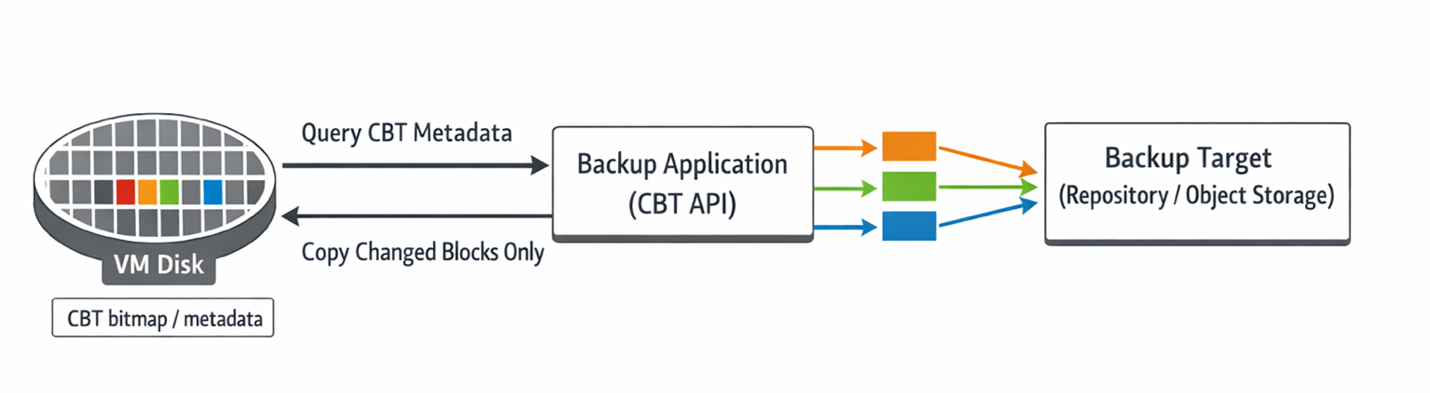
Take for example a VM with a 2 TB disk that sees a daily churn (or change) of 50 GB. Without CBT, the backup application will need to read up to the entire 2 TB disk to determine what has changed and then send that data to the backup target.
With CBT, the backup application only needs to read 50 GB (plus some metadata overhead), resulting in 40x less source reading and transfer.
Delivering for the Veeam and Red Hat Community
By implementing CBT at the virtualization platform layer, Red Hat OpenShift users can enjoy the benefits, irrespective of the underlying storage they use.
It is also worth noting that storage-array CBT would produce even better performance, and fortunately the CSI standard has been updated to include exactly that, defined in KEP-3314, which was primarily authored by Kasten engineers.
The Veeam team is actively collaborating with its storage partners to implement this standard in their CSI drivers. In the interim, we are excited to innovate with our colleagues at Red Hat, driving enhancements for our shared customers and the community at large.
The post Red Hat and Veeam: Driving Industry Innovation Together for Kubernetes Storage and Backup Performance appeared first on Veeam Software Official Blog.
from Veeam Software Official Blog https://ift.tt/j8Pti4u
Share this content: